
Introduction
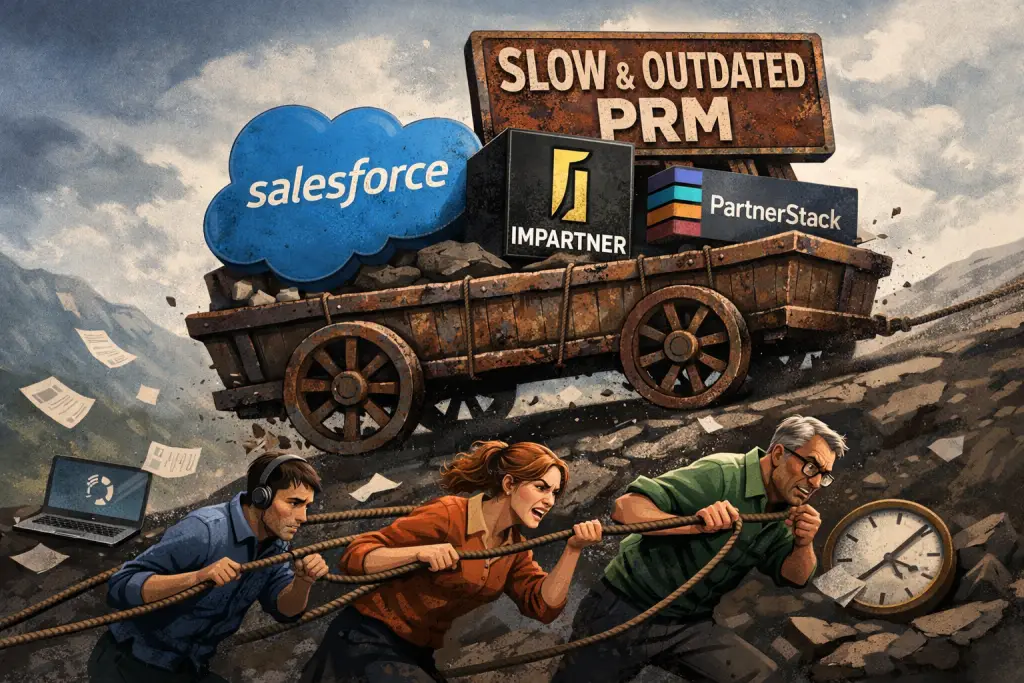
Partner teams don't hate PRMs. They hate what PRMs have become and how they often fail to support the effective use of a partner portal. Understanding the role of a partner portal is crucial for optimising partner relationships and increasing overall efficiency.
The PRM Adoption Illusion
On paper, PRMs promise everything: partner onboarding, enablement, deal registration, MDF, and reporting governance. In reality, partner managers work around the system, partners log in once… maybe, data becomes outdated, and the real work happens in Slack, email, spreadsheets, and CRM notes.
The core problem: traditional PRMs are designed for reporting, not for how partner teams actually operate.
1. PRMs Are Built for Executives, Not Partner Managers
Most PRMs are sold top-down. Executives want dashboards, forecasts, control, and standardization. Partner managers need speed, flexibility, context, and execution support. Traditional PRMs prioritize rigid workflows, mandatory fields, complex configurations, and heavy admin overhead — so partner managers spend more time feeding the tool than growing the ecosystem.
2. Partners Don't Live in Your PRM
Your partners don't wake up wanting to log into your portal. They already operate within their CRM, email, Slack or Teams, and customer conversations. Traditional PRMs create friction by requiring partners to learn new systems, remember logins, manually update deals, and navigate generic libraries. When partners disengage, companies blame motivation — but it's actually experience design.
3. Configuration ≠ Strategy
Assuming correct PRM configuration ensures program success is flawed. PRMs don't design partner models, incentives, activation strategies, or partner journeys — they only reflect existing design quality. Poor underlying strategy becomes more structured confusion.
4. Heavy Systems Slow Down Fast-Moving Teams
Modern partner teams need agility to test new partner types, adjust incentives, launch campaigns, and abandon failing initiatives. Traditional PRMs make changes expensive, requiring admin involvement and weeks for updates, making teams risk-averse instead of experimental.
5. What Actually Works: A Partner Operating System
High-performing teams start with clear partner roles, simple activation paths, defined success metrics, and lightweight execution layers — then introduce technology as support, not constraint. The shift is from asking "How do we force partners into our system?" to "How do we help partners succeed with minimal friction?"
Where CinnaLab Fits In
CinnaLab addresses teams outgrowing spreadsheets, over-engineered PRMs, and manual chaos. It emphasizes fast activation, clear workflows, visibility without overhead, and supporting the partner program teams actually want — enabling strategy without replacing it.
Final Thought
PRMs failed not because concepts were wrong, but because markets evolved while tools stagnated. Modern partner teams need clarity, speed, and execution support.